Physique is ‘the mental imprint of a brand’s physical image, as a sensory perception”. Its power comes from its automatic nature, which escapes formal or rational thinking. It’s related to the primacy effect, psycho-speak for the power of first impressions. Once imprinted, it decides whether we ‘accept’ products that don’t fit the ‘physiqual’ mould.
If you haven’t already, read the last two posts, here and here for a fuller introduction.
In this post: what can be done to escape the trap of the first impression, the gravitational pull of physique?
1. Don’t Step, Leap—But Keep the Bungee Tied
Switch to a category so unlike the original that the original physique seems to not apply.
One answer to reach escape velocity may be to switch to a category so unlike the original that the original physique seems to not apply. Such a long cross-category leap, of course, needs a central idea to make it work. The brand needs an external reference figure outside its product sphere, an external pole star if you like, by which it finds its way. It could be a founder, a central idea, or values-in-use (which can be sensed, unlike those on some mission/vision/values ‘statement’), or better, more than one of these acting together.
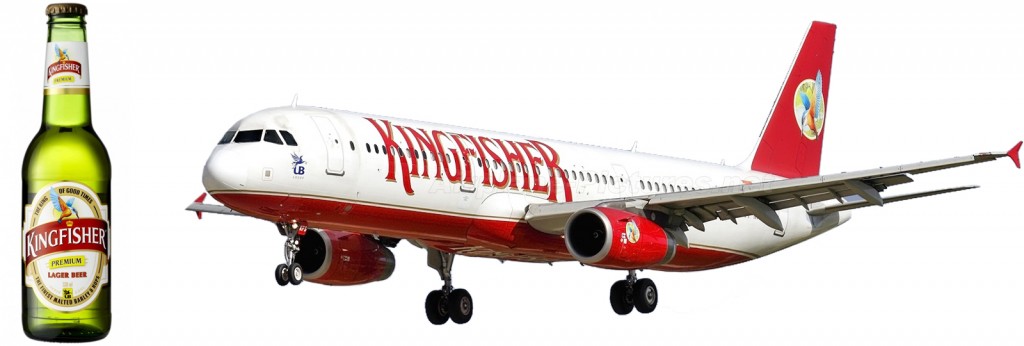
So, Yamaha’s diversity (pianos, tennis racquets and motorbikes, and that’s not all) can be said to be bound by the central theme of leisure in modern living (a value dear to the first Mr Yamaha). Kingfisher successfully transferred its value of flamboyant hedonism from beer to airlines (the lager picture, says the ICD wag), and so no physique interfered. Similar values also attach easily to the physique of the magnificent Mr Mallya (who is also an external reference figure): yachts, bungalows and supermodels fit as easily with beer as with a sort of stylish airline.
2. Regency: an Antidote
The last events in a series are weighted more than the ones in the middle of a sequence of facts.
Another answer is to exploit the recency effect, the opposite of the primacy effect: the last events in a series are weighted more than the ones in the middle of a sequence of facts. In the Tata growth story, for example, both recency and the external reference figure are at work.
So it helped that Tata Steel was preceded by the Taj (hotel) brand, whose close association to the head of the dynasty gave a new physical dimension to the Tata corporate concept, without using the the Tata name. So long as they don’t front the Tata name, Tanishq and Titan, like Taj before them, (the original T-series, says the office comedian) can enjoy the Tata assurance—connected to the founder’s reputation—and escape being weighed down by Tata’s industrial, nation-building physique.
3. The Age of Impressions
But act quickly! The duration of the original imprinting may matter. The Taj Mahal in Bombay opened a few years before the steel and power businesses. Hyundai Motors’ Accent was launched within four years of the iconic Santro. Hyundai has been a bit more successful with its longer wheelbase cars than Maruti has, which waited seven years to launch the 1000, the forerunner of the cramped but enthusiastic Esteem, which it astonishingly continued till 2008.
From then, Maruti has had a long, slow slog to the C segment, via the old Baleno and SX4 (both discontinued) and the gone-in-60-seconds, long-bodied Baleno Altura. The Baleno is back, but cut to size, as a hatchback (good move) and has great early bookings. The compact DZire which is built on the Swift platform, finally inched past the little Alto, only in July 2015. Restaging can work, if you keep at it, as recency overcomes primacy—slowly.
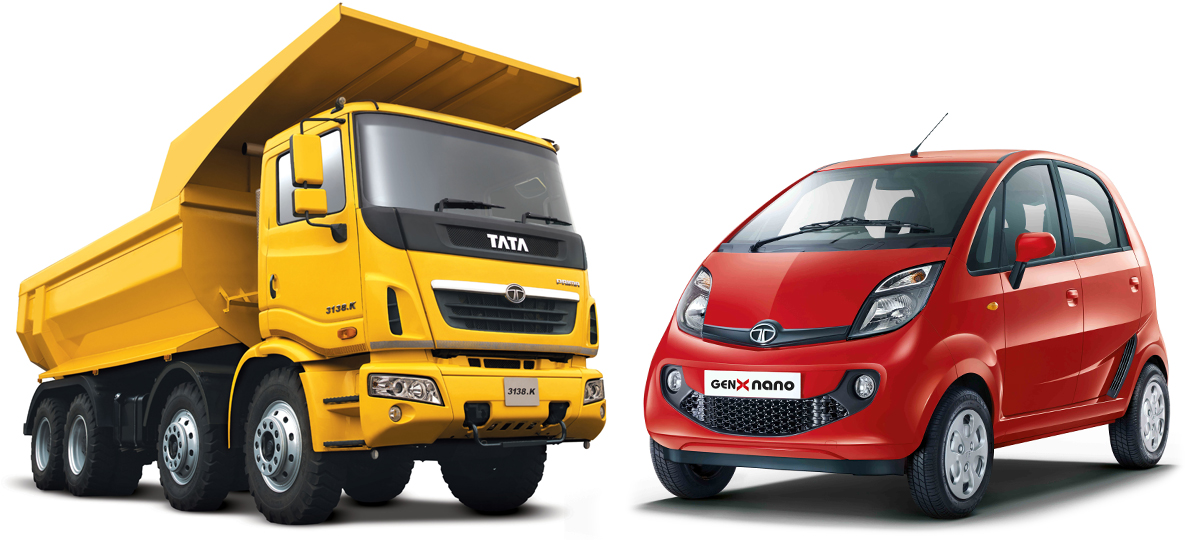
As for Tata Motors, it really must ask whether lifestyle cars are within its physiqual reach. The Nano is a baby; it doesn’t fit the mould created by generations of successful trucks and grey, smoky steel plants, which better suit the Safari or Sumo. Says Guenter Butschek, its latest CEO tasked with the turnaround of Tata Motors, “We really need to consider how we position the brand.” Shyamal Majumdar’s incisive piece (Business Standard) argues for pulling the Nano. From a physique point of view, it makes sense. But it may not fit the ‘car is a car is a car’, psychology-phobic way management often thinks. Tata have solved this problem before, as I’ve pointed out earlier.
Limitations of Physique
Not all product categories and brands excite this ‘physi-qual’ reaction; and further, it needs sensing and interpretation.
Not all product categories and brands excite this ‘physiqual’ reaction; and further, it needs sensing and interpretation. It is far from a complete explanation of brand-product fit. Physique is a fit matter for further research.
In a future post, I will reveal — no, make that speculate on — when physique applies, and when it’s a stumbling block and when not. If I get enough requests!
Tailpiece/Stop Press
On the same day as the Pininfarina story, the papers reported on the (relatively) poor sales of Royal Enfield’s much-admired Continental GT. The Harley Street 750, which costs about two and half times as much, almost overtook it in 2015. Price-product-position play a role, but does the Continental GT, in some subtle sense, lack the Royal Enfield physique?
Since the time of writing, the Mahindra KUV (connotes a small SUV?) in eye-catching orange, was launched with XUV-ish shape, but not size; perhaps a good move in physique terms. Royal Enfield now has a Himalayan model, which seems on first looks closer to the Enfield physique than the GT.

Naresh Khanna
April 19, 2016Have read the three physique parts. First of all do write more. Please do continue. I am not sure what you are writing about — physique, branding, primacy, recency. The automobile and motorcycle discussions are good and useful since many other lessons, thoughts or metaphors can also come from that industry — especially for the Indian economy and our ideas of mobility in all its senses.
After part 2, I thought of mentioning the Tata Nano, and lo, there it was in part 3. I was in Germany at a press event related to printing (heavy-metal and engineering for culture), the day Ratan Tata announced or introduced the Nano — to the huge consternation of my European colleagues (all of whom seem to be car buffs) — “Do the Indian’s really think they can engineer the world’s cheapest car for Rs. 100,000 (US$ 2,000 at the time). . . . and, “Oh no, all the poor Indians will buy a Nano, and there will be no petrol left for the rest of us and now global warming will surely be upon us.”
The irony of course has been the dismal failure of the Nano car (just as it has become a catchword in the digital printing industry). At the same time Tata Motors have somehow sidestepped all their Indian failures (and even their admitted defeat in the muscular SUV categories by Mahindra) with their somewhat deft takeover and handling of Jaguar Land Rover.
What does all this have to do with anything? Well, some of us thought something from the iconic designs of the past from JLR may somehow rub off on Tata Motors, let alone their quality skills in heavy metal manufacturing.
Other perhaps tangential but interesting riffs could come from the discussion of where we are motoring to. Are we really going anywhere or simply brand migrants — aspirational or economic rationalists. I do not want to impose any constraints on wherever Itu is going but one of the most important migrations seems to be to the increased number of features and automation in the smallest (earlier cheapest) cars. It’s a fact that Indians first look for value (or perceived value) products and then as we become wealthier or more comfortable, seem to look for how we can enhance these. We love to decorate our cars and add fancy decals, hubcaps and weird lights. And now we seem to want to buy the smallest cars with the newly available factory-fitted options such as airbags, automatic transmissions, navigation systems and reversing cameras.