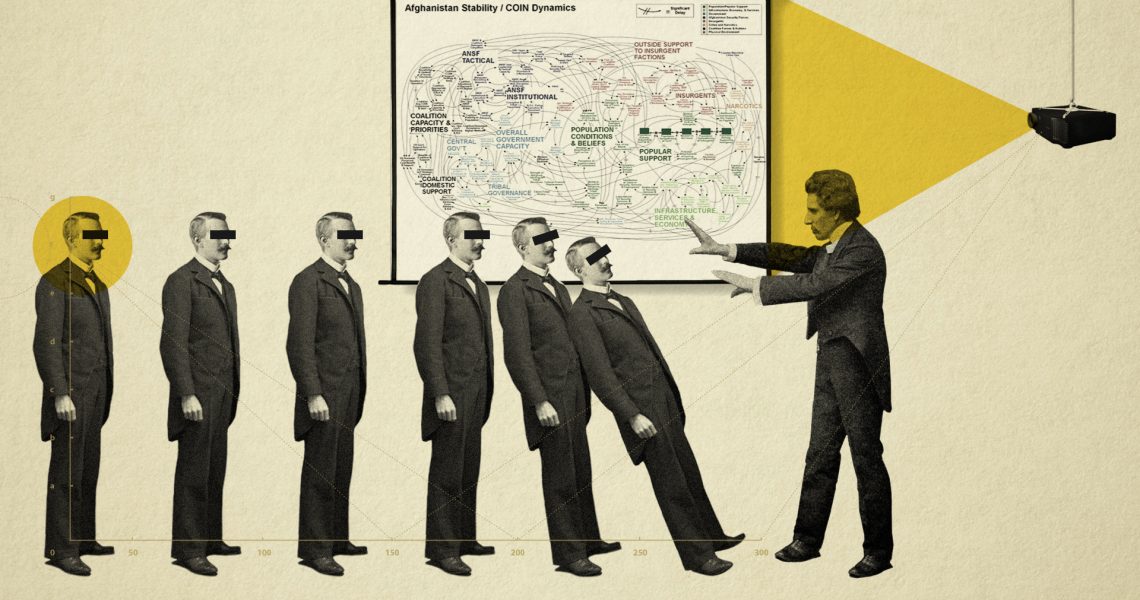
Some innovations succeed to the point of redefining the problem they tackle. Some give way to better ones, or having served their time, fade into the section of the graveyard reserved for the no-longer-needed. Yet others fail flagrantly, and quickly: tagged as laughable, or a good idea poorly executed, or ill timed. A broad consensus rules. Surely it ought to be impossible for an innovation to suffer all of these fates at once? To be a ubiquitous necessity, a permanent, empowering right, a watershed; and yet, a scourge, a threat, and an evil joke. Yet that unlikely status of divider-in-chief has attached itself to Microsoft’s PowerPoint, the class-defining presentation software.
design thinking
Distress Signals
First, a recipe. Find some lettering, carefully painted or printed on something solid, like wood or metal, an old nameplate, maybe, Then get to work on it with sandpaper, until the edges of the letters vanish here and there, and the entire surface is pitted, scratched and otherwise damaged. Now dust it off and step back to admire the new urgency of the letters; meaningless text now animated with meaning, as if each gash and speck tells a story.
Design and the future
Design, as a thinking style, is starting to be recognised for its contribution to tackling today’s most complex problems. Its role may be even more important in the future, or the Future, that permanently fascinating horizon which occupies our dreams and fantasies. But not just in making the products and services of tomorrow.
A Seat At The High Table
For at least half a century, design has been seeking a seat at the high table. Its leaders, a motley bunch of academics, ‘visionaries’ and the odd forward-thinking practitioner, believe that design should have a greater influence in the public sphere. Why not a presence in government or at least on company boards?
Specialists vs Generalists
A human being, wrote sci-fi writer Robert Heinlein, should be able to fight, write poetry and die gallantly, among 18 more things. Specialisation, he famously said, is for insects.
Visionary Position: Design on Top
Look around you and you likely wouldn’t know it, if you are reading this in print in a developing country, but business is getting very, very attracted to design. If, on the other hand, you are reading this on a screen in a G-8 country, this may seem like settled fact. This is a consummation that designers have long and devoutly wished, and while isn’t, not yet, a ‘best practice’ that corporations adore, it’s no longer just conference-room hype. Power and money demonstrate that.